
You're Burning Cash on Leads While Your Competitors Book Them
The real reason your marketing budget isn't turning into booked moves — and the fix that costs less than one lost job per month.
Aj Basagre
Lion's Den Booking Service
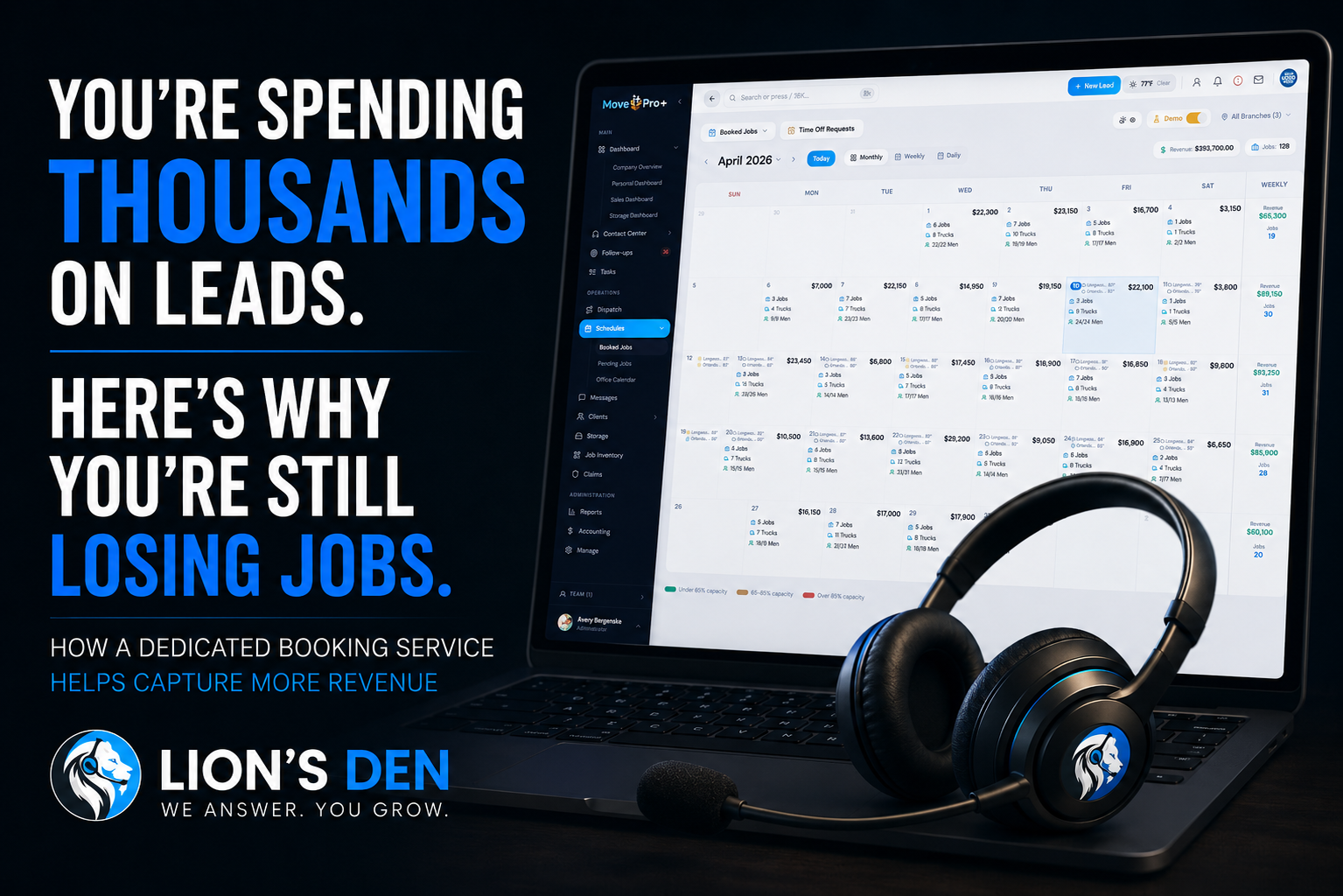
You just spent $4,000 on leads this month. How many of them actually booked?
If you're like most moving companies, the answer is sobering — and the problem usually isn't your ads, your pricing, or your reviews.
It's what happens after the lead arrives.
The moving industry in 2026 is more competitive than it has ever been. Customer expectations have changed. Technology has changed. The way people shop for moving services has changed.
Yet many moving companies are still relying on the same lead management process they used five or even ten years ago.
As a result, they're spending thousands of dollars every month generating leads while unknowingly losing potential customers before a conversation even begins.
The frustrating part?
Most of these lost opportunities have nothing to do with pricing, service quality, or reputation.
They're lost because nobody responded fast enough.

The Marketing Trap Many Moving Companies Fall Into
When bookings slow down, the first instinct is often to buy more leads.
Increase the Google Ads budget.
Invest in Local Service Ads.
Purchase leads from third-party providers.
Boost social media campaigns.
Invest in SEO.
While marketing is important, many moving companies are focusing on the wrong problem.
The issue isn't always lead generation.
The issue is what happens after the lead arrives.
A moving company can spend thousands of dollars attracting prospects, but if those prospects aren't contacted quickly and consistently, marketing dollars are being wasted.
More leads won't solve a broken follow-up process.
The Modern Customer Doesn't Wait
Today's customers are shopping differently.
When someone needs a moving company, they aren't contacting one business and waiting three days for a response.
They're contacting multiple companies within minutes.
They're requesting online quotes.
They're filling out website forms.
They're calling several movers in the same afternoon.
And they're often booking with the company that responds first.
Think about your own buying habits.
When you need a service, how long are you willing to wait for a callback?
Most consumers expect responses almost immediately.
If they don't hear back, they move on.
The moving industry is no different.
The company that responds first often earns the opportunity to build trust.
The company that responds last is usually competing from behind.
Your Team Is Already Wearing Too Many Hats
Most moving companies don't intentionally neglect leads.
Their staff is simply overwhelmed.
A typical office team is responsible for:
- Answering phones
- Scheduling jobs
- Dispatching crews
- Managing customer concerns
- Processing payments
- Handling claims
- Coordinating logistics
- Managing paperwork
Lead follow-up becomes just another task on an already overflowing list.
Even highly organized teams struggle during busy seasons.
A lead comes in.
Then another.
Then a customer calls with a billing question.
A crew needs assistance.
A dispatch issue appears.
Before anyone realizes it, hours have passed and that lead has already booked elsewhere.
This isn't a people problem.
It's a capacity problem.

The Hidden Revenue Leak Most Owners Never Measure
Most business owners closely monitor:
- Revenue
- Expenses
- Payroll
- Fuel costs
- Advertising spend
But very few track the value of opportunities that never convert because they were never properly managed.
Let's use a simple example.
Imagine your average move generates $3,000 in revenue.
If your company loses only five jobs each month due to missed calls, delayed follow-up, or inconsistent communication, that's:
$15,000 per month
Or:
$180,000 per year
And that's assuming only five lost jobs.
Many companies lose significantly more opportunities than they realize.
The challenge is that these losses don't show up on financial statements.
They're invisible.
You don't see the customers who never called back.
You don't see the prospects who chose another mover.
You only see the bookings that happened—not the revenue that slipped away.
Why Speed Has Become a Competitive Advantage
For years, moving companies competed primarily on price and service quality.
Those factors still matter.
But today, responsiveness is becoming just as important.
Customers want answers.
They want communication.
They want confidence that their move is being handled by professionals.
Fast response times create confidence.
Consistent follow-up creates trust.
Professional communication creates credibility.
Companies that deliver these experiences are gaining an advantage over competitors that rely on voicemail, delayed callbacks, and inconsistent processes.
The companies winning in 2026 aren't necessarily the cheapest.
They're often the most responsive.
What a Dedicated Booking Service Actually Does
Many people hear "booking service" and think of a traditional answering service.
That's not what modern booking services are designed to do.
A dedicated booking service becomes an extension of your business.
Its purpose is to ensure that every opportunity receives immediate attention.
That means:
- Answering incoming calls
- Responding to inquiries quickly
- Scheduling appointments
- Following up with prospects
- Keeping opportunities active
- Providing a professional customer experience
Most importantly, it creates consistency.
No matter how busy operations become, leads continue moving through the pipeline.
No opportunity gets forgotten.
No inquiry sits untouched for days.
Why Consistent Follow-Up Matters More Than Ever
One of the biggest misconceptions in sales is that customers book immediately.
In reality, many prospects need multiple touchpoints before making a decision.
They compare estimates.
They discuss options with family members.
They adjust timelines.
They gather additional information.
Without a structured follow-up process, many of these opportunities disappear.
Not because they weren't interested.
Because nobody followed up.
The companies that consistently stay in touch are often the companies that ultimately win the job.
Follow-up isn't about being pushy.
It's about staying present.
Combining People and Technology
The most successful moving companies are combining dedicated booking teams with modern technology.
Technology alone can't build relationships.
People alone can't efficiently manage hundreds of opportunities.
The real advantage comes when both work together.
This is where Lion's Den and MoveitPro+ create value.

Lion's Den helps ensure that leads are contacted, nurtured, and guided through the sales process.
MoveitPro+ provides the tools needed to manage those opportunities efficiently through:
- Lead management
- Estimating
- Scheduling
- Customer communication
- Reporting
- Performance tracking
Together, they help moving companies create a sales process that is faster, more organized, and more scalable.
The Companies That Will Win in 2026
The moving industry isn't slowing down.
Competition is increasing.
Customer expectations are rising.
Response times are becoming more important.
Companies that continue relying on outdated processes will find it harder to compete.
The companies that invest in responsiveness, consistency, and customer experience will continue to grow.
Not because they have more leads.
Because they do a better job with the leads they already have.
Final Thoughts
Most moving companies believe growth starts with generating more leads.
But often, growth starts by capturing more value from the opportunities already coming through the door.
Every missed call.
Every delayed response.
Every forgotten follow-up.
Represents revenue that could have become a booked move.
A dedicated booking service helps ensure those opportunities don't slip away.
Because in today's moving industry, success isn't determined by who generates the most leads.
It's determined by who responds the fastest, follows up the best, and creates the strongest customer experience.
And that's exactly where the real competitive advantage begins.